NFPA 96 for Richmond Hill Restaurants
The NFPA 96 Standard for Ventilation Control and Fire Protection of Commercial Cooking Operations is the rulebook for how a restaurant exhaust system in Richmond Hill gets inspected and cleaned. It covers the whole grease path from the hood to the rooftop fan, names 0.078 inches as the grease depth at which cleaning is due, and publishes inspection intervals from monthly to annual by type and volume of cooking. The Ontario Fire Code references NFPA 96, which is how it reaches your kitchen. Richmond Hill Hood Cleaning references the published NFPA 96 standard and is not affiliated with NFPA.
Last updated September 2026
NFPA 96 standards in plain terms
NFPA 96 is a technical standard written by the National Fire Protection Association. You can read its scope on the NFPA 96 page at nfpa.org. For a kitchen owner it comes down to three duties.
Measure the grease. Once deposit anywhere in the exhaust path reaches 0.078 inches, about the thickness of a coin edge, that surface is due for cleaning.
Inspect on a schedule set by your cooking. A kitchen that chars and fries all day is checked far more often than one that reheats soup twice a week.
Keep the paper. Each inspection and cleaning is recorded with the date, the parts of the system covered and who did the work, and the record stays where an inspector can see it.
NFPA 96 hood cleaning frequency: cooking volume vs inspection interval
The interval follows what you cook and how much of it, not how big the kitchen is.
| Interval | Cooking volume vs type named in NFPA 96 | A Richmond Hill kitchen that fits |
|---|---|---|
| Monthly | Solid-fuel cooking | A charcoal kebab grill on Yonge Street. |
| Quarterly | High volume: charbroiling, wok cooking, 24-hour operation | A wok line in a Highway 7 plaza, or a late-night bar kitchen. |
| Semi-annual | Moderate volume | A lunch-and-dinner cafe on Bayview Avenue. |
| Annual | Low volume: churches, seasonal kitchens | A church hall kitchen in Oak Ridges. |
Source: the published NFPA 96 standard. These are minimums. A heavier menu can need more.
What does grease-laden vapours mean?
Grease-laden vapours are the hot mix of oil, fat, steam and smoke that rises off a cooking surface and turns back into liquid grease wherever it meets cooler metal.
This phrase decides whether NFPA 96 applies at all. A fryer, a charbroiler or a wok burner makes grease-laden vapours, so the exhaust above it falls under the standard. A steam kettle on its own does not. The vapour cools as it moves through the filters, the plenum, the duct and the fan, and each stretch collects its share. That layer is what gets measured against 0.078 inches.
How NFPA 96 connects to the Ontario Fire Code
The Ontario Fire Code is the law, and it references NFPA 96 for commercial cooking exhaust. The code carries the duty; the standard supplies the detail.
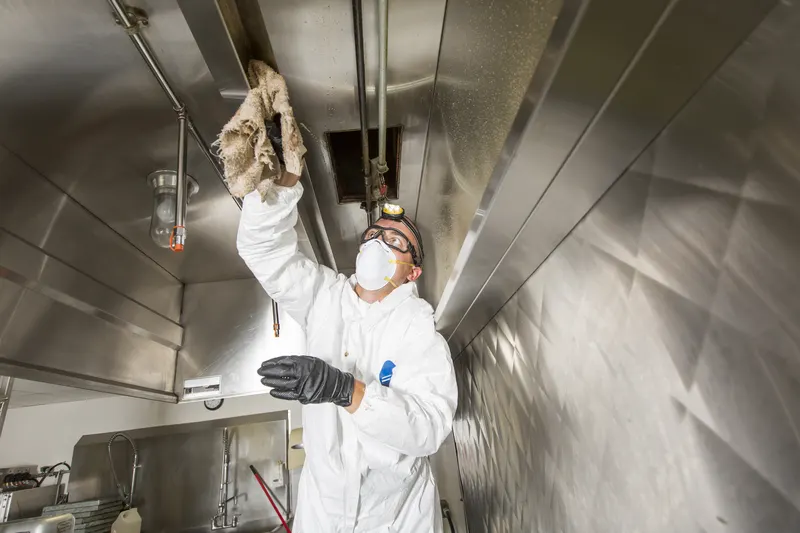
Neither document licenses hood cleaners. Neither one hands out a credential to a company.
Fire inspections in Richmond Hill and Thornhill east of Yonge
Richmond Hill Fire and Emergency Services enforces the Ontario Fire Code in the city. Its Fire Inspectors work under the Fire Protection and Prevention Act, 1997, and inspect on request, on complaint, for a safety concern and on a routine basis.
Thornhill east of Yonge Street sits inside the City of Markham, so Markham Fire and Emergency Services is the fire authority for kitchens on that side. Either way, have the most recent cleaning record ready, keep the filters seated, and make sure the duct access panels and the roof hatch can be reached. A record that names only the hood leaves the duct and fan unaccounted for.
Public health is a separate visit. York Region Public Health inspects every food premises in York Region and publishes routine, complaint and re-inspection results through its YorkSafe program. A premises that passes posts a green Proof of Public Health Inspection sign at the main entrance, and a red Closed sign means an immediate health hazard. The green sign covers food safety. It says nothing about your exhaust system, which is a fire matter.
Top-rated certified kitchen exhaust cleaners in Richmond Hill: what to look for
No certification for kitchen exhaust cleaners exists under NFPA 96. NFPA writes standards; it does not certify technicians, approve companies or inspect kitchens.
People search for "certified kitchen exhaust cleaners" and "NFPA 96 certified technicians" every month, and the honest answer is that nobody issues that credential. The Ontario Fire Code does not license hood cleaners and the fire service does not endorse them. What you can ask for is proof: a signed health and safety certificate referencing the published NFPA 96 standard, before-and-after photographs of every cleaned surface, and proof of WSIB coverage and liability insurance before work starts.
What the certificate says. Which parts of one system were cleaned (hood, filters, plenum, duct, fan), on what date, by which contractor, and that the work references the published standard.
What it does not say. It is not a fire inspection result. It covers only the parts it lists. It does not make anyone certified. The scope of each part is on the hood cleaning services, hood vent cleaning and exhaust fan repair pages.
Who is responsible for NFPA 96 compliance, the tenant or the landlord?
The party that runs the kitchen usually carries NFPA 96 compliance, which in most Richmond Hill plazas is the restaurant tenant. The lease decides who answers for the roof and the building.
A landlord still has a stake. A duct that loads up in one unit is a fire risk for every unit sharing the building, and a fire order can land on the property as well as the tenant. Franchise kitchens often have head office setting the interval and filing the certificate. Paperwork needs by kitchen type are on the who we serve page.
Where to find NFPA 96 hood cleaning near me in Richmond Hill
Richmond Hill Hood Cleaning reads kitchens against the published standard from Langstaff to Lake Wilcox, and in Thornhill east of Yonge, during a free walk-through.
Services are on the services page and the full coverage list on the areas served page.
Next step: call 289-796-1166 or request a written quote. Have your last certificate handy if you have one.
NFPA 96 in Richmond Hill: frequently asked questions
Is NFPA 96 law in Ontario?
NFPA 96 is a standard, not a statute. The Ontario Fire Code is the law, and it references NFPA 96 for commercial cooking exhaust, so the standard applies through the code.
How often does NFPA 96 say a hood must be cleaned?
NFPA 96 sets inspection intervals, and cleaning follows when an inspection finds grease at 0.078 inches or more. The intervals run monthly for solid fuel, quarterly for high volume, semi-annual for moderate and annual for low volume.
Does a church or seasonal kitchen fall under NFPA 96?
Any commercial cooking that makes grease-laden vapours falls under NFPA 96. Churches and seasonal kitchens sit on the annual interval, the longest one in the standard.
Does the green YorkSafe sign mean my exhaust is compliant?
The green Proof of Public Health Inspection sign covers food safety only. The exhaust system is a fire matter under the Ontario Fire Code.
Which edition of NFPA 96 applies in Richmond Hill?
The edition that applies is the one the Ontario Fire Code references. The fire service, not the contractor, is the authority on which edition it enforces.